Quick Answer
Choose MechDog if you are a beginner, teaching STEM, or learning embedded development. It runs on an ESP32, supports Scratch, Python, and Arduino, and can be expanded with a micro:bit board, a robotic arm, and LEGO-compatible structures. It is the fastest way to learn servo control and basic quadruped gaits without fighting a Linux stack first.
Choose PuppyPi i if your goal is ROS and AI vision. It is built around a Raspberry Pi, and with a lidar and arm added it can do object recognition, SLAM navigation, and simple embodied tasks such as pick-and-carry.
Choose ROSPug if you need the most compute and the most agile body. It uses an NVIDIA GPU for on-device deep learning and a 12-DOF chassis that can sidestep, walk diagonally, and handle more advanced obstacle avoidance.
1. Why the Choice Matters
Quadruped robots are popular in classrooms and AI labs because they combine animal-like locomotion with real terrain handling. The catch is that beginners, ROS learners, and research users want very different things.
- Beginners care about how easy the programming path is.
- AI developers care about cameras, ROS, and a working software stack.
- Advanced users care about onboard compute, extra joints, and room to run heavier algorithms.
Match the platform to the goal, not the other way around.
2. What Each Robot Is For
ROSPug, MechDog, and PuppyPi are all Hiwonder quadrupeds aimed at learning, AI work, and maker projects. They share a four-legged layout, but they are not interchangeable.
2.1 MechDog — Compact Embedded Starter
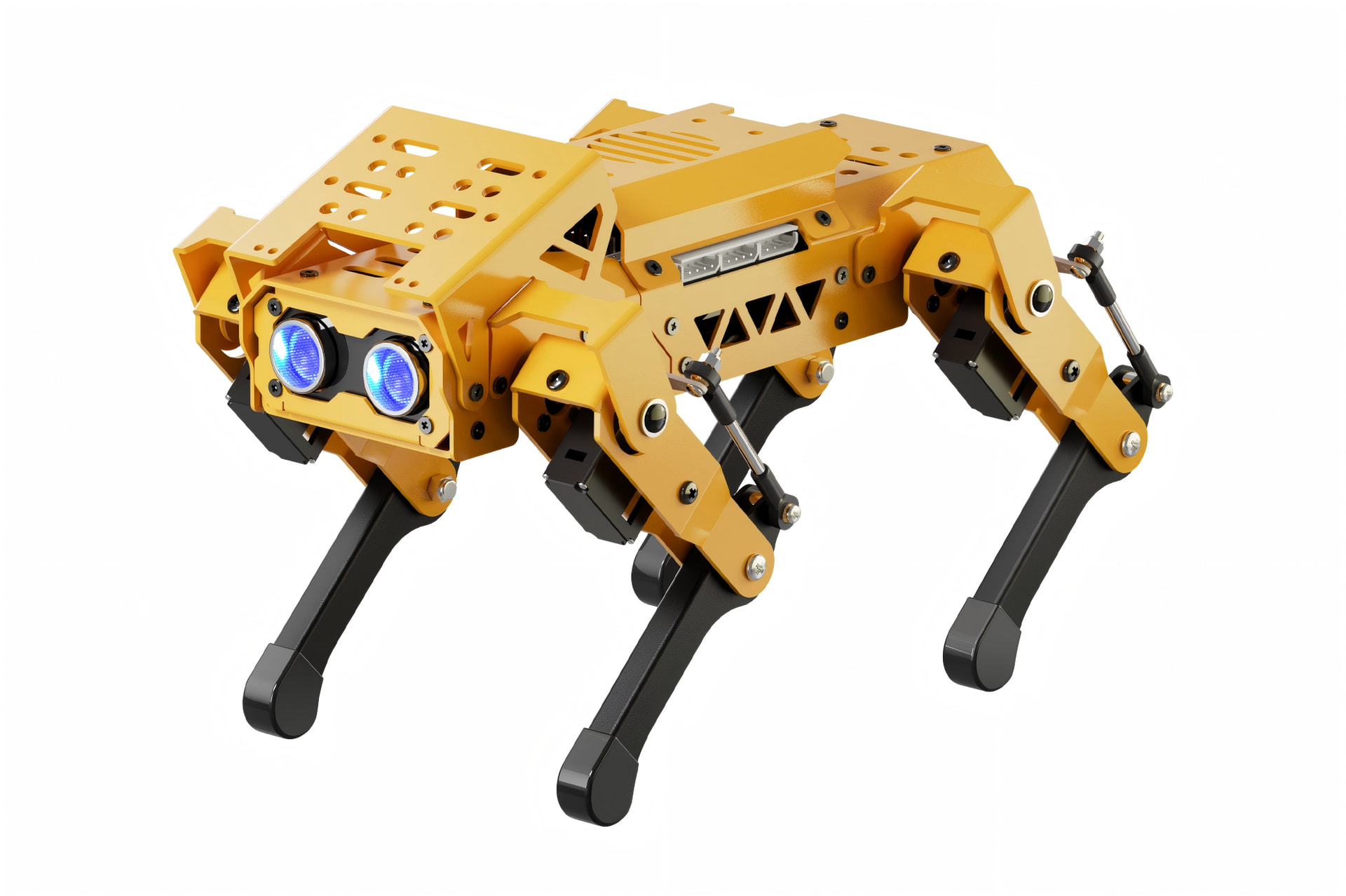
Best for: STEM teaching and embedded practice.
Hardware: ESP32 main controller (micro:bit expansion supported), linkage legs, and eight high-speed coreless servos. Optional add-ons include an ESP32-S3 vision module, WonderEcho voice module, ultrasonic and IMU sensors, a 3-DOF arm, and LEGO-compatible parts.
Software: Scratch, Arduino, and Python. Hiwonder’s inverse-kinematics stack handles body pose and dynamic balance.
Battery: 7.5 V, 1500 mAh, 5C high-rate Li-ion pack.
Why Choose It: You can start with scratch, then move into Arduino or Python, and still get real gait control. The accessory ecosystem is rich enough to cover sensors, basic vision, and servo fundamentals without a steep Linux learning curve.
2.2 PuppyPi — ROS and Vision Workhorse
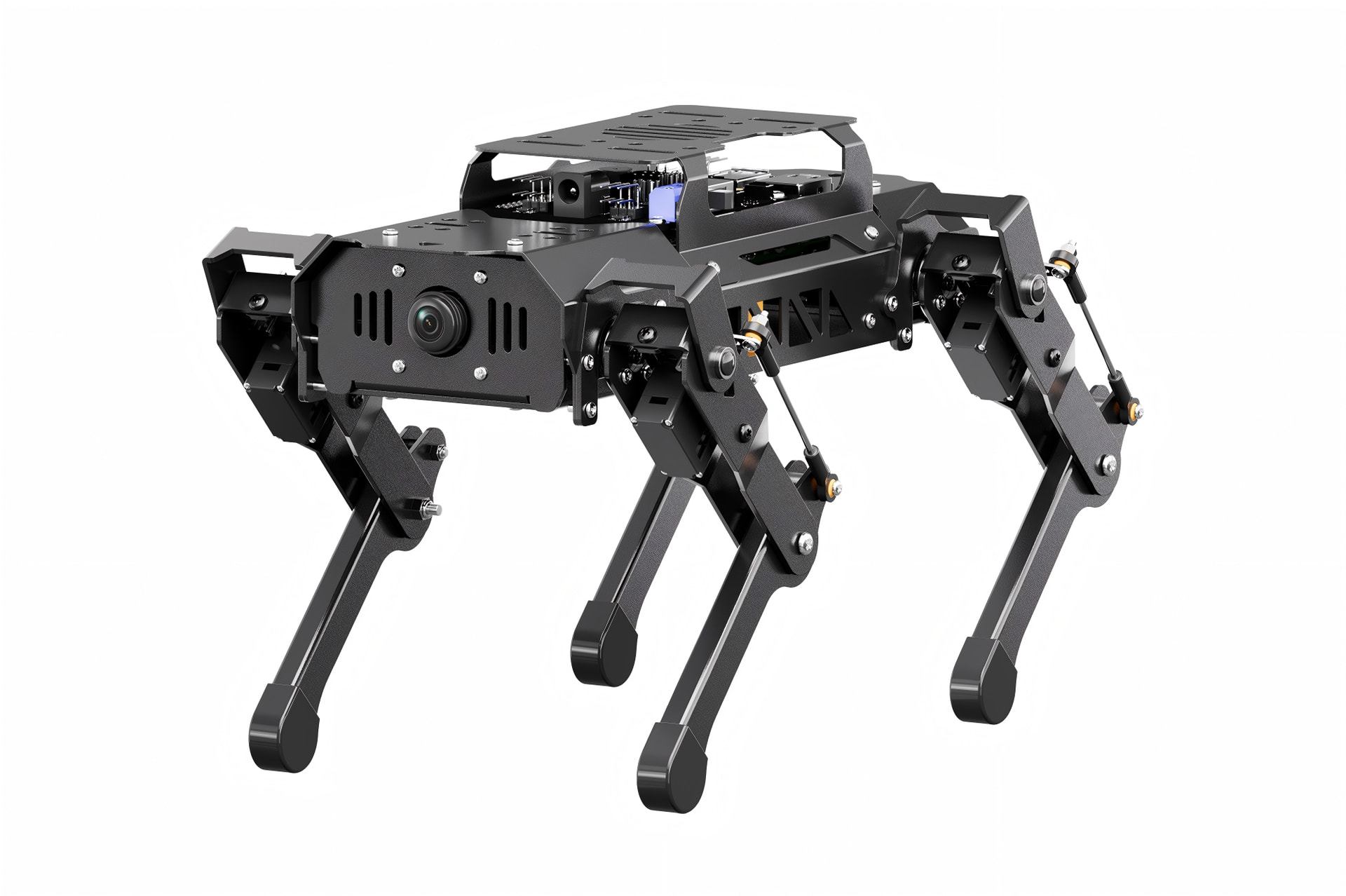
Best for: AI vision, ROS, and practical intelligent applications.
Hardware: Raspberry Pi 4B or 5 as the brain, plus a wide-angle camera in the head. It can take extra sensors, a 3-DOF arm, a WonderEcho Pro voice box, and a TOF lidar.
Software: Linux, ROS 1 or ROS 2, and Python. Includes inverse kinematics, OpenCV vision routines, and Gazebo simulation.
Battery: 7.4 V, 2200 mAh, 10C high-rate Li-ion pack.
Why Choose It: The course material around PuppyPi is complete and structured. Add lidar and you can map a room, follow voice commands, and run navigation-plus-carrying projects that feel like real embodied AI.
2.3 ROSPug — High-Compute Research Platform
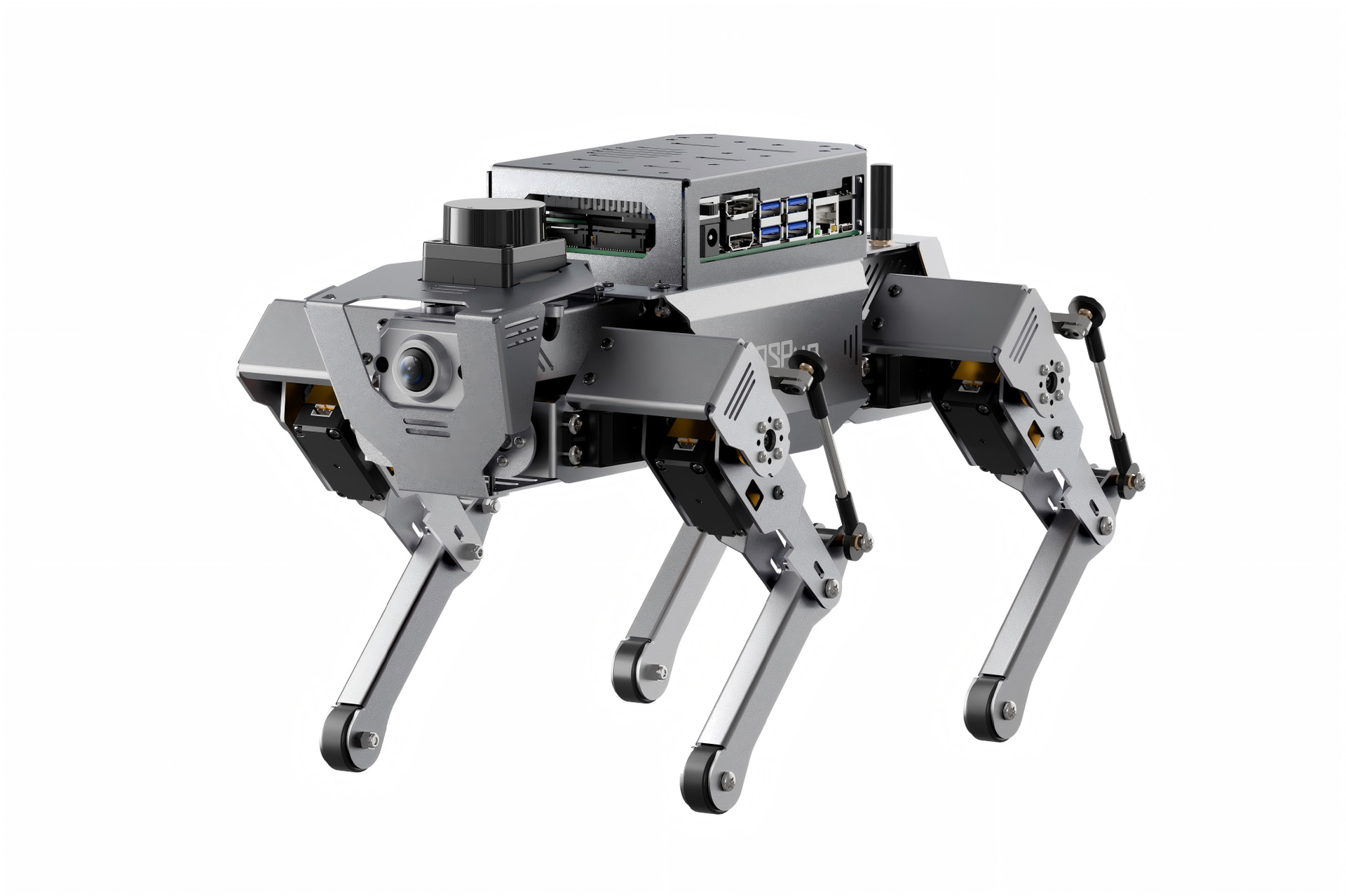
Best for: on-device deep learning and more demanding ROS research.
Hardware: NVIDIA Jetson Nano, twelve high-voltage smart bus servos (hip joints included), peak joint torque of 30 kg·cm, TOF lidar, and a wide-angle camera.
Software: Linux and Python, with the same inverse-kinematics, OpenCV, and Gazebo support as PuppyPi — but with GPU headroom behind it.
Battery: 11.1 V, 3500 mAh, 5C LiPo pack, chosen for higher instantaneous current.
Why Choose It: Among the three, this one has the most compute and the most degrees of freedom. The Jetson GPU can run heavier models locally, and the 12-DOF body can walk sideways, adjust posture, and juggle vision, SLAM, and planning at the same time.
3. The Differences That Actually Matter
3.1 ESP32 vs Raspberry Pi vs Jetson Nano
ESP32 is the gentlest on-ramp. Three programming styles, no Linux tax, and a clean ladder from blocks to code.
Raspberry Pi gives you a full Linux and ROS environment. Most beginner-to-intermediate vision pipelines and basic embodied apps run well here.
Jetson Nano adds a dedicated GPU. That is what you want when models need to stay on the robot and several perception tasks have to run together.
3.2 8 DOF vs 12 DOF
MechDog and PuppyPi use eight degrees of freedom — two joints per leg. Each leg swings in a forward-back plane. To turn in place, the robot has to use a tank-style gait: longer steps on one side, shorter on the other.
ROSPug adds a hip abduction joint on every leg, bringing the body to 12 DOF. It can crab-walk sideways, move on a diagonal, and tilt the body slightly to keep balance. The extra joints are the difference between “it walks” and “it can place its feet more like an animal.”
3.3 Battery
High-rate cylindrical packs on MechDog and PuppyPi favor stable voltage and usable runtime for class demos.
ROSPug’s higher-voltage LiPo is there for burst current: Jetson Nano peaks plus twelve high-torque servos all hitting at once.
3.4 Servos
MechDog and PuppyPi use eight lightweight, high-speed coreless servos (around 8 kg·cm). They are responsive and easy to learn on.
ROSPug uses twelve high-voltage smart bus servos at up to 30 kg·cm, with position feedback. More torque, tighter control, and enough strength for heavier gaits and payloads.
4. Side-by-Side Specs
| Spec | MechDog | PuppyPi | ROSPug |
|---|---|---|---|
| Controller | ESP32 | Raspberry Pi 4B / 5 | NVIDIA Jetson Nano |
| Size | 214 × 126 × 138 mm | 266 × 149 × 190 mm | 334 × 211 × 210 mm |
| Degrees of freedom | 8-DOF body + optional 3-DOF arm | 8-DOF body + optional 3-DOF arm | 12-DOF body (hip joints included) |
| Servos | HPS-0618SG high-performance coreless | HPS-0618SG high-performance coreless | High-voltage smart bus servos |
| Servo torque | 8 kg·cm at 8.4 V | 6 kg·cm at 8.4 V | 30 kg·cm at 12 V |
| Lidar | None | Optional TOF lidar | TOF lidar |
| Battery | 7.4 V 1500 mAh 5C high-rate Li-ion | 7.4 V 2000 mAh 10C high-rate Li-ion | 11.1 V 3500 mAh LiPo (stronger burst current) |
| Programming | Scratch / Arduino / Python | Python / C / C++ / JavaScript | Python / C / C++ / JavaScript |
| Standout strength | Easiest path from blocks to code; rich sensors and brick-style expansion | Full ROS curriculum; lidar unlocks SLAM and navigation | Most GPU power and mobility; can run deep models and heavy multitasking on board |
FAQ
Q1. I have no ROS background. Which one should I buy?
Start with MechDog if you are a complete beginner. Scratch and Arduino let you learn gait control without setting up Linux. If you already write Python and want a structured ROS path, PuppyPi is the better next step.
Q2. What are the differences between 12 DOF and 8 DOF?
Sideways motion and finer posture control. An 8-DOF dog can only swing its legs forward and back, so turning is a skid-steer circle. A 12-DOF dog can abduct at the hips, which means crab walking, diagonal steps, and small body-tilt corrections.
Q3. PuppyPi and ROSPug can both run SLAM. How different is the experience?
It comes down to compute. PuppyPi does 2D SLAM on the Raspberry Pi CPU and is fine for class projects and basic navigation. ROSPug’s Jetson GPU keeps mapping and path planning snappier, and it can keep a heavier vision stack running at the same time — for example SLAM plus learned obstacle avoidance.
Q4. Can PuppyPi handle a “voice + navigation + arm grasp” project?
Yes. Fit the TOF lidar, the 3-DOF arm, and the WonderEcho Pro voice module, and that full pipeline is a supported project on PuppyPi.