Selection Guide | How to Choose the Right MentorPi Series ROS2 Robot?
The MentorPi series is a robot development platform built on Raspberry Pi 5 and ROS2. It includes three models: Ackermann chassis (A1), Mecanum wheel chassis (M1), and Tracked chassis (T1). All three models share the same computing core, perception system, AI capabilities, and software ecosystem. The main differences lie in the chassis kinematics and suitable application scenarios.
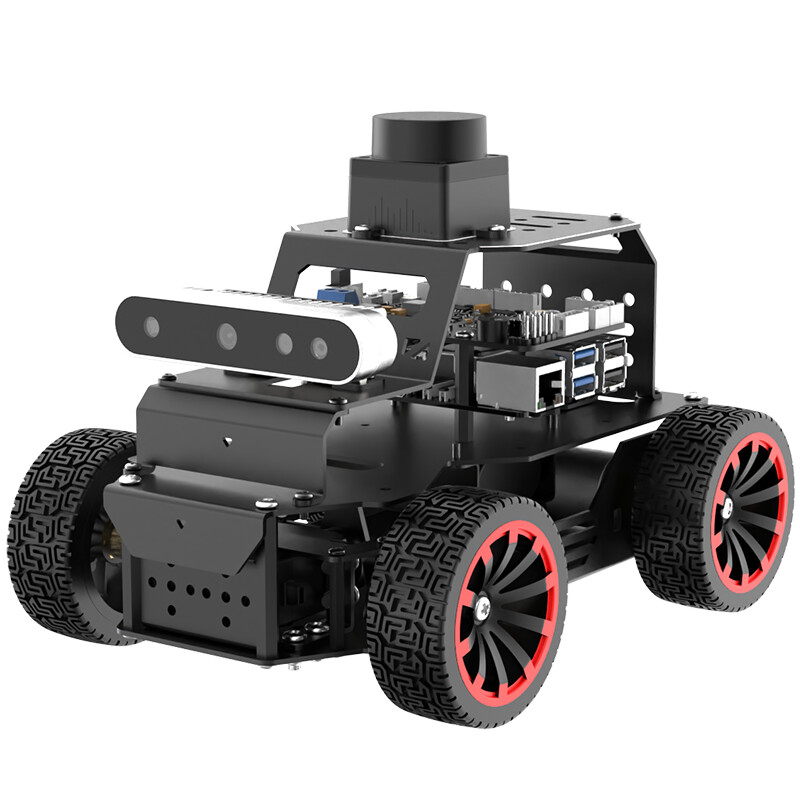
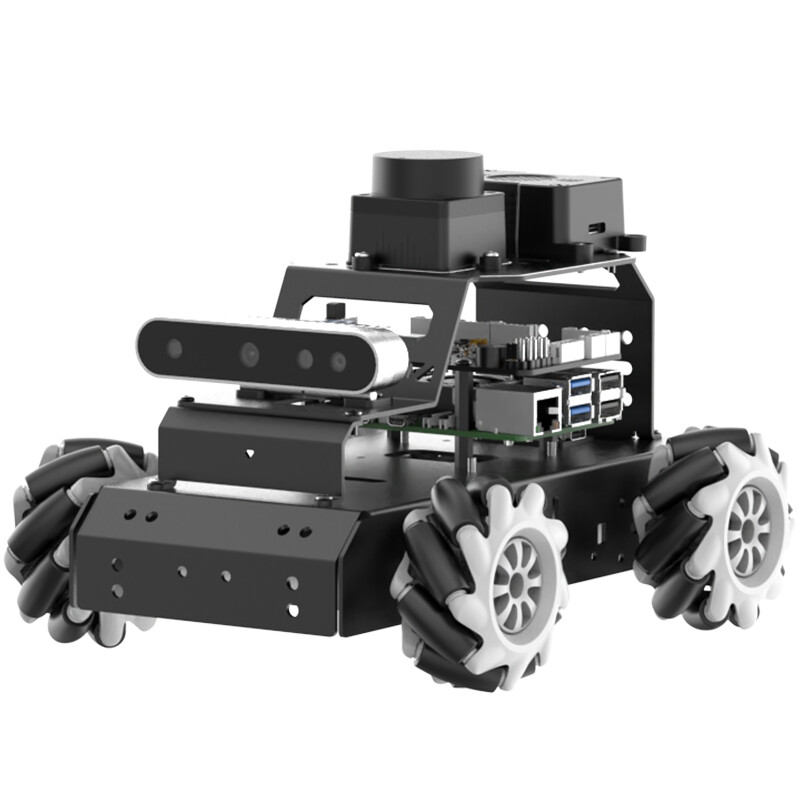
Core Differences in Chassis Kinematics
At the functional level (large AI models, visual recognition, SLAM mapping & navigation, voice interaction), the three models are completely identical. The only difference is the chassis type and the motion characteristics it determines. The comparison is as follows:
| Comparison Dimension | MentorPi A1 | MentorPi M1 | MentorPi T1 |
|---|---|---|---|
| Chassis Type | Ackermann steering chassis | Mecanum wheel chassis | Tracked suspension chassis |
| Motion Method | Front-wheel servo steering + rear-wheel drive | Four-wheel coordinated 360° omnidirectional motion | Left-right track differential drive |
| Lateral Movement | Not supported | Supported | Not supported |
| Core Kinematic Model | Ackermann geometry (steering angle, wheelbase, track width) | Omnidirectional kinematics (decoupled vx, vy, ω) | Differential kinematics (left-right wheel speed) |
Model Selection Recommendations
MentorPi A1 — Best for Real Vehicle Models and Autonomous Driving
MentorPi A1 adopts a car-like structure with front-wheel steering and rear-wheel drive. Its motion constraints are closest to those of a real vehicle. The mathematical model involves the geometric relationship between wheelbase, track width, steering angle, and turning radius.
Recommended scenarios:
- Line following, autonomous driving simulation, and road/lane visual tasks
- Learning ROS projects that closely match the constraints of unmanned vehicle chassis
MentorPi M1 — Best for Omnidirectional Movement and Indoor Robots
MentorPi M1 is equipped with Mecanum wheels and achieves omnidirectional movement in the plane through independent speed combinations of the four wheels. It is particularly suitable for precise positioning and movement in space-constrained indoor environments.
Recommended scenarios:
- Omnidirectional kinematics
- Indoor SLAM, Nav2 navigation, target tracking, and human-robot interaction
MentorPi T1 — Best for Differential Control and Complex Terrain Traversability
MentorPi T1 uses a tracked chassis structure and steers by the speed difference between the left and right tracks. It supports in-place rotation.
Recommended scenarios:
- Inspection tasks, complex indoor floors, and light obstacle-crossing projects
- Tracked differential chassis kinematics, speed closed-loop control, odometry, and sensor fusion
Selection Decision Summary
| Core Requirement | Recommended Model |
|---|---|
| Autonomous driving algorithms, path tracking, vehicle kinematics verification | MentorPi A1 |
| Indoor omnidirectional movement, localization & navigation, lateral/diagonal movement demos | MentorPi M1 |
| Complex terrain traversal, differential control, in-place turning inspection | MentorPi T1 |
All three models are fully equivalent in upper-layer application capabilities such as large AI models, visual perception, and mapping & navigation. Selection should be based solely on chassis kinematic characteristics and the actual deployment environment.