Quick Answer
- Choose LanderPi if you want a well-rounded ROS 2 learning platform. Pair 3D depth vision with a 6-DOF arm and focus on mobile grasping plus arm kinematics.
- Choose JetRover if you need stronger AI compute and perception. It supports multiple chassis kinematics and is better for advanced AI vision, high-precision SLAM, and high-payload mobile grasping.
- Choose ROSOrin Pro if you want to explore embodied AI. It combines a high-compute controller with large language models and the OpenClaw agent stack for intelligent interaction and autonomous task execution.
1. Why the choice matters
ROS 2 mobile robots now commonly ship with SLAM navigation, multimodal AI demos, and arm-based grasping. On paper they look similar. In practice they differ a lot in compute, sensors, chassis design, and arm torque.
Some platforms are built for a lower barrier to entry and lighter AI interaction. Others can actually run heavier algorithms, more precise mobile manipulation, and serious embodied-AI work. The right pick depends on what you want to learn, how deep you want to go on algorithms, and what kind of projects you plan to run.
2. Product overview
Hiwonder’s LanderPi, JetRover, and ROSOrin Pro are all native ROS 2 mobile manipulator platforms. Each includes SLAM navigation, 3D vision, and multimodal AI examples. They are positioned differently in compute ceiling, perception hardware, chassis, and arm configuration.
LanderPi — ROS 2 mobile manipulator learning platform
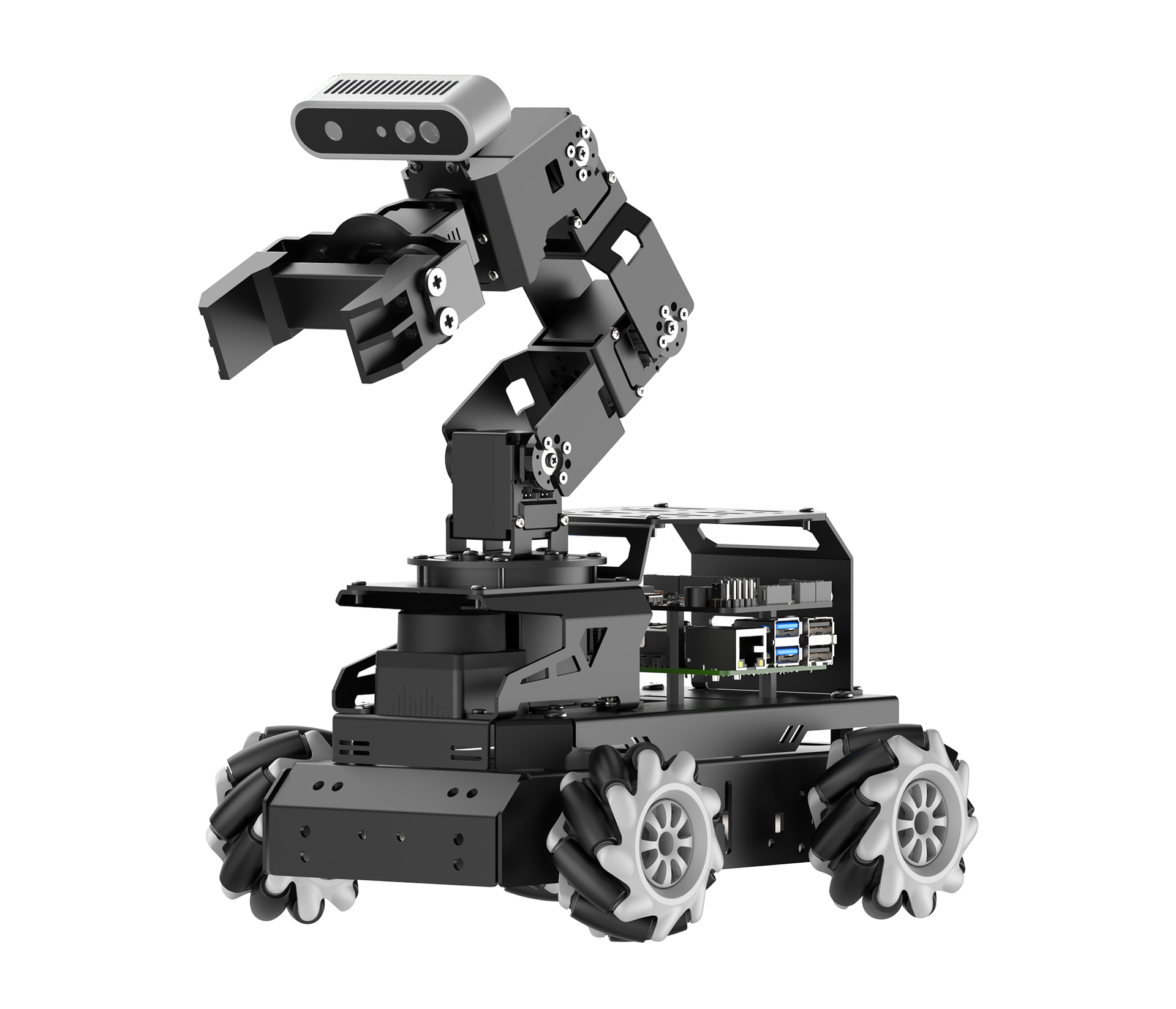
Positioning: ROS 2 development, arm motion control, and mobile grasping.
Hardware: Raspberry Pi 5. Choice of mecanum, Ackermann, or tracked chassis. AI voice box, STL-19P D500 LiDAR, Aurora 930 Pro depth camera, and a 6-DOF arm rated at 6 kg·cm.
Strengths: The depth camera and LiDAR give you depth, point clouds, and spatial localization for navigation and 3D grasping. The 6-DOF arm is a good way to learn forward and inverse kinematics, then move on to coordinated chassis-and-arm control.
JetRover — high-compute AI vision and mobile manipulation platform
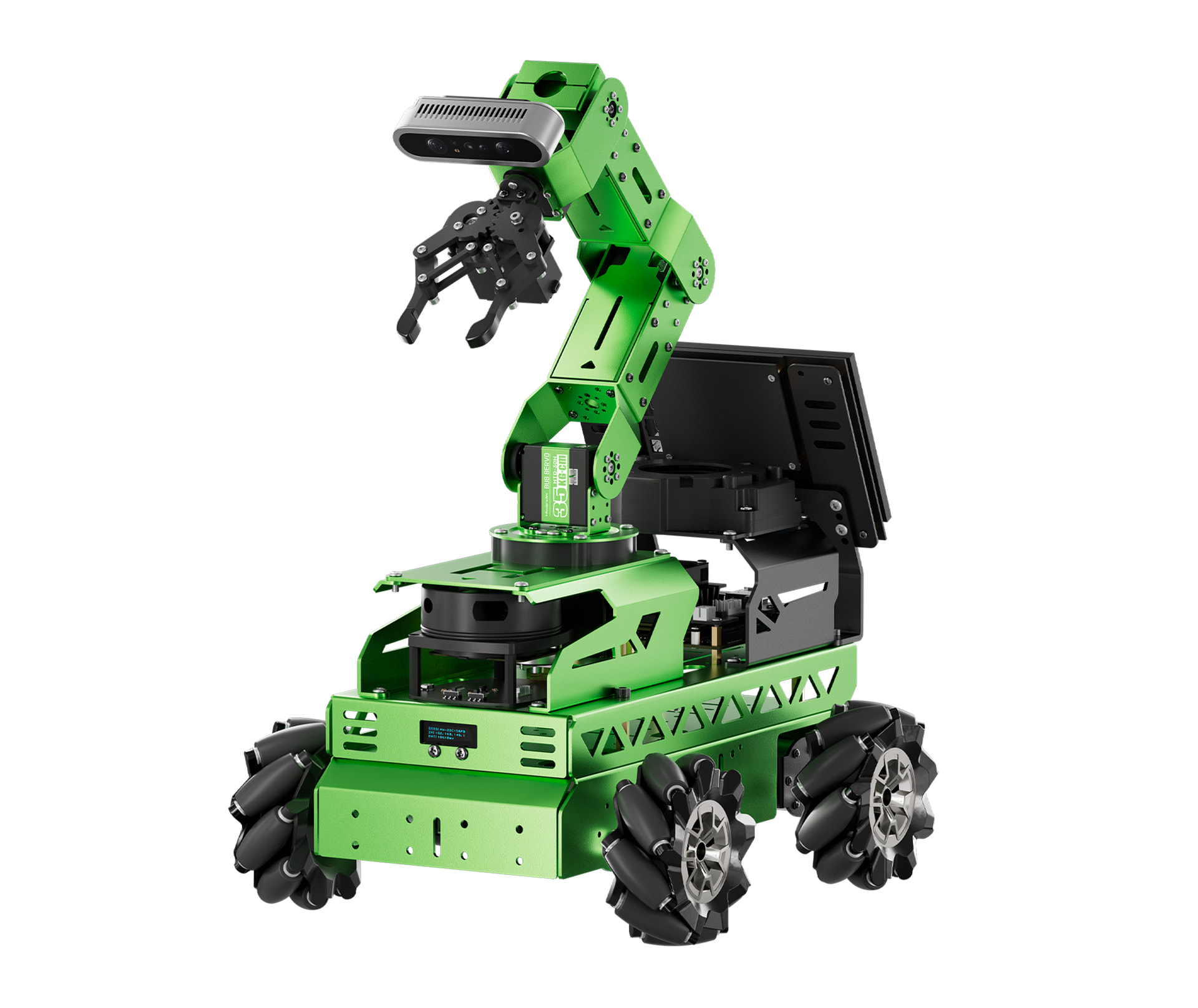
Positioning: Plenty of compute and top-tier sensing, aimed at high-precision SLAM and heavier mobile manipulation.
Hardware: Raspberry Pi 5 or the NVIDIA Jetson lineup (Nano / Orin Nano / Orin NX). 6-DOF arm with 35 kg·cm servos. Chassis options include mecanum, Ackermann, tracked, or a three-in-one chassis. Depth camera is an Orbbec DaBai, with higher RGB resolution and frame rate (1080p @ 30 fps) and better recognition accuracy at the same distance. LiDAR options include a customized Slamtec A1 (balanced and stable) or an EAI G4 (higher-end, better for complex mapping). Optional 7-inch display, AI voice box, or an integrated 6-mic array.
Strengths: High-spec depth camera, higher-rate LiDAR, and a much stronger arm make it realistic to do object detection, 3D localization, path planning, and high-payload pick-and-place in more demanding scenes. If you want to go deeper on AI vision, on-device deep learning, and complex mobile manipulation, JetRover leaves more headroom.
ROSOrin Pro — full-stack platform for embodied AI
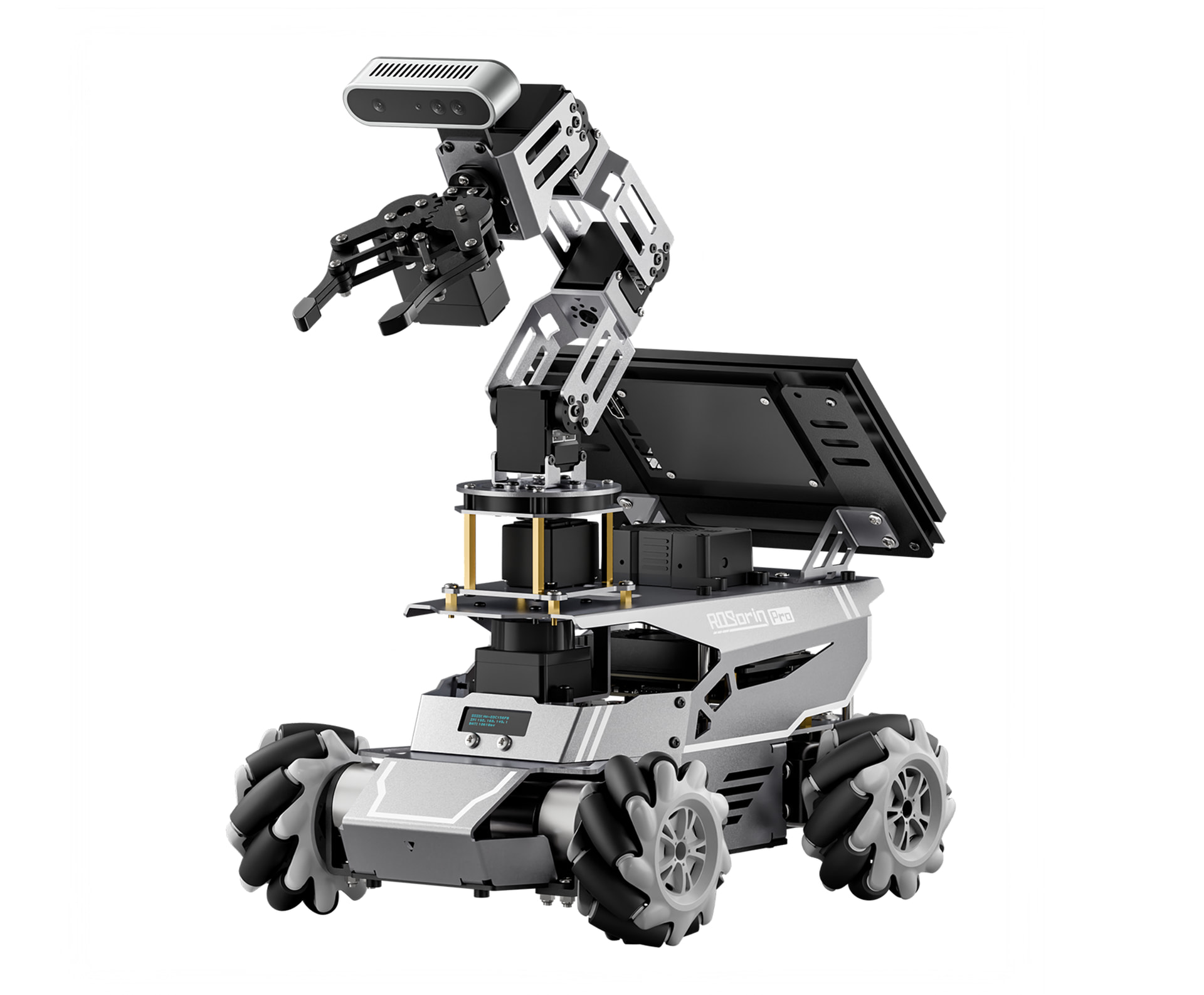
Positioning: Cleaner industrial look, aimed at advanced ROS 2 work and embodied-AI applications.
Hardware: Raspberry Pi 5 or the full Jetson lineup. Swing-arm independent-suspension mecanum chassis. COIN-D6 LiDAR, Aurora 930 Pro depth camera, 6-DOF arm rated at 21 kg·cm, AI voice box, and a 7-inch touchscreen.
Strengths: On a Jetson, you get strong on-device AI. The platform is built around large models (cloud and local) plus the OpenClaw agent framework. Combined with a smoother suspended chassis, it is a solid vehicle for natural-language interaction, task planning, and higher-level embodied-AI research.
3. The differences that actually matter
3.1 Depth cameras: Aurora 930 Pro vs. Orbbec DaBai
Aurora 930 Pro covers most teaching use cases and ordinary 3D visual grasping.
Orbbec DaBai uses a dedicated depth processor and supports 1920×1080 @ 30 fps. RGB quality is clearly better, which helps with harder visual tracking and finer point-cloud / depth work.
In short: if you just need “3D vision that works,” Aurora is usually enough. If image quality and perception-heavy algorithms matter, DaBai is the better sensor.
3.2 Standard mecanum vs. suspended mecanum
A standard mecanum chassis gives 360° holonomic motion — easy strafing and turning — and is fine on flat indoor floors for learning mobile control.
A swing-arm / independent-suspension mecanum chassis keeps all four wheels in better contact with the ground and absorbs bumps. That improves traction, smoothness, and usability on uneven floors.
3.3 LiDAR options: COIN-D6, STL-19P D500, Slamtec A1, and EAI G4
These cover different mapping and navigation needs.
Entry / teaching units such as COIN-D6 and STL-19P D500 typically sample around 4k–5k points per second. That is enough for everyday SLAM, path planning, and obstacle-avoidance labs.
The customized Slamtec A1 and the EAI G4 are aimed at messier environments and more advanced algorithms. The EAI G4 samples at about 9k points per second, so you get denser scans. That usually helps large-area mapping with GMapping, Hector, Cartographer, and similar stacks.
3.4 Arm servo torque
All three use a 6-DOF arm, so you can study kinematics and spatial trajectory planning. Payload is another story.
- LanderPi (6 kg·cm) is for lightweight pick-and-place.
- ROSOrin Pro (21 kg·cm) is enough for typical grasping and transport labs.
- JetRover (35 kg·cm) has the most punch and is the one built for heavier, more stable mobile pick-and-place.
4. Spec comparison
| Spec | LanderPi | JetRover | ROSOrin Pro |
|---|---|---|---|
| Controller | Raspberry Pi 5 | Raspberry Pi 5 / NVIDIA Jetson series | Raspberry Pi 5 / NVIDIA Jetson series |
| Chassis | Mecanum / Ackermann / tracked | Mecanum / Ackermann / tracked / 3-in-1 chassis | Swing-arm suspended mecanum |
| Arm | 6-DOF | 6-DOF | 6-DOF |
| Peak servo torque | 6 kg·cm @ 7.4 V | 35 kg·cm @ 11.1 V | 21 kg·cm @ 11 V |
| Depth camera | Aurora 930 Pro | Orbbec DaBai | Aurora 930 Pro |
| LiDAR | STL-19P D500 | Custom Slamtec A1 / EAI G4 (higher performance) | COIN-D6 |
| Display | — | 7-inch touchscreen | 7-inch touchscreen |
| Battery | 7.4 V 2200 mAh | 11.1 V 6000 mAh | 11.1 V 6000 mAh |
| Large models & OpenClaw | Cloud large models | Cloud and local large models | Cloud and local large models + OpenClaw |
| Best at | Arm control, 3D vision, mobile grasping | Top-tier sensing, high-performance SLAM, advanced AI vision | Looks and embodied-AI experience |
| Buy it if… | You want a systematic ROS 2 + kinematics + 3D grasping path | You need high-rate LiDAR, stronger vision, and a high-payload arm | You want on-device AI headroom and a full embodied-AI stack |
FAQ
Q1. I already know some ROS 2 and want to go deeper on visual grasping. Which one?
If your next step is arm control, 3D vision, and mobile grasping, start with LanderPi. If you already know you want heavier AI and higher-performance robot work, look at JetRover or ROSOrin Pro.
Q2. Can I learn AI vision without an NVIDIA Jetson?
Yes. A Raspberry Pi 5 can handle basic 3D vision and simple tracking. For heavier deep-learning models, local inference, or larger deployments, Jetson is the more comfortable platform.
Q3. I care most about high-precision mobile manipulation. Which one?
JetRover. The flagship configuration pairs a ~9k-sample EAI G4 LiDAR with the DaBai depth camera, which helps mapping, recognition, and spatial localization. The 35 kg·cm 6-DOF arm can also take more demanding pick-and-place and transport tasks.
Q4. What does swing-arm suspended mecanum actually buy you versus a normal mecanum chassis?
The suspension keeps the four wheels in better contact with the ground. That improves stability and motion quality, and it handles imperfect floors better.
Q5. Why does JetRover’s 3-in-1 chassis matter?
Different chassis imply different motion models. Mecanum is holonomic (full 360° motion). Ackermann behaves more like a car. Tracks handle rough ground better. Being able to swap chassis on the same software stack makes it much easier to see how kinematics change SLAM, planning, and navigation.
Q6. I want to focus on embodied AI. Which platform?
ROSOrin Pro. On Jetson it has real on-device GPU compute, and it is built around large models plus OpenClaw. That combination is aimed at natural-language understanding and autonomous task planning — a better fit for lab work and more advanced makers.
Q7. All three support SLAM. How different is the result?
Sensors, compute, and chassis change what “good enough” looks like.
- LanderPi is fine for standard SLAM labs with a depth camera and LiDAR.
- JetRover has the stronger camera, LiDAR, and Jetson option, so it holds up better in more complex mapping and localization.
- ROSOrin Pro adds a suspended mecanum chassis and enough AI compute to combine navigation with large models and OpenClaw — closer to intelligent fetch-and-carry / embodied-AI demos.