Quick Answer
- Choose ArmPi Ultra if you want the best value ROS 2 robotic arm for learning and basic projects.
- Choose JetArm if your priority is strong local AI / GPU performance on NVIDIA Jetson.
- Choose NexArm ROS if you need higher mechanical performance and want to work with Hugging Face LeRobot and advanced Embodied AI projects.
Product Overview
All three are desktop robotic arms designed for ROS development, 3D vision, and intelligent grasping. They differ mainly in computing power, mechanical performance, and target use cases.
1. ArmPi Ultra: The Cost-Effective ROS 2 3D Vision Arm
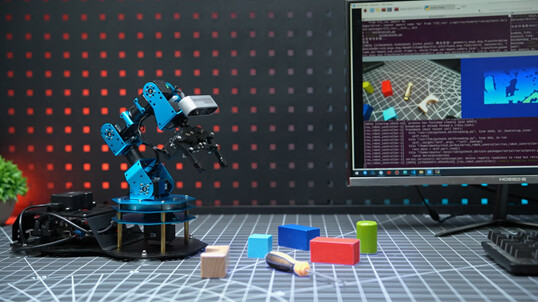
- Positioning: The ultimate entry-level tool for ROS vision development.
- Compute & Vision: Powered by a Raspberry Pi 5 and an Aurora 930 Pro 3D depth camera. Easily handles RGB-D data acquisition, spatial localization, and AI voice interaction.
- Mechanics: 358 mm reach with 25 kg·cm intelligent serial bus servos.
2. JetArm: Built for Edge AI and Deep Learning
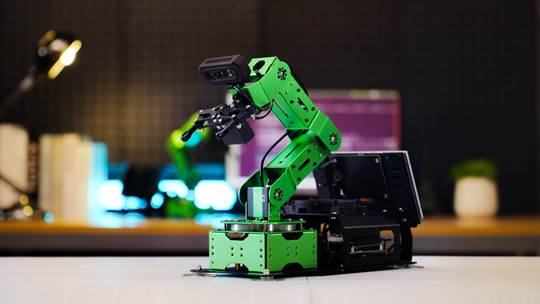
- Positioning: Built for deploying deep learning and complex AI vision algorithms.
- Compute & Vision: Natively supports the NVIDIA Jetson lineup (Nano, Orin Nano, and Orin NX) for efficient local AI inference. Equipped with a Gemini Plus 3D depth camera for richer depth data and higher perception accuracy, making it ideal for demanding hand-eye coordination tasks.
- Mechanics: 429 mm reach and 35 kg·cm torque, offering a strong balance between performance and agility.
- Why Choose It: Ideal for developers focused on object detection, visual tracking, or running foundation models on the edge.
3. NexArm ROS: The High-Performance Platform for Embodied AI
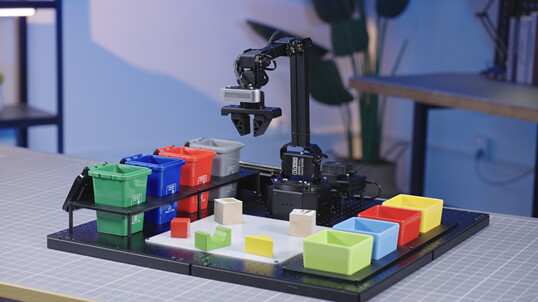
- Positioning: A flagship platform balancing flexible compute with high control precision.
- Compute & Vision: Supports both Raspberry Pi 5 and the full NVIDIA Jetson series for full-stack ROS 2 and foundation model deployments. Uses the Aurora 930 Pro 3D camera for reliable object detection and tracking.
- Mechanics: 500 mm reach with 65 kg·cm dual-shaft magnetic encoder serial bus servos. Features 12-bit real-time magnetic feedback, trapezoidal acceleration, and curve interpolation for smooth, precise motion.
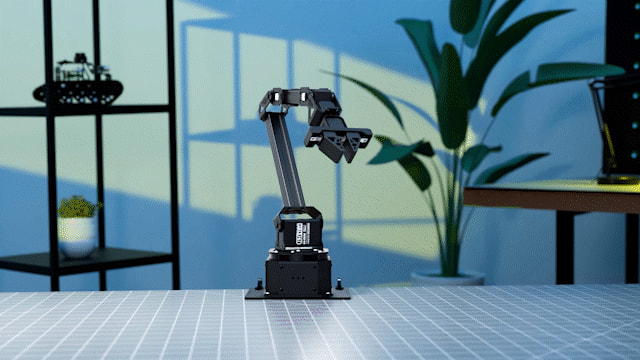
- Ecosystem: Deeply integrates with the Hugging Face LeRobot framework for VLA model training and imitation learning. Supports smart sorting setups, multi-robot coordination, slide rails, and conveyors for advanced R&D.
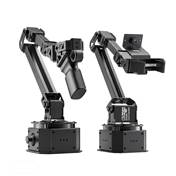
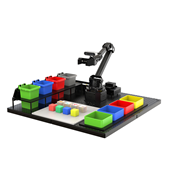
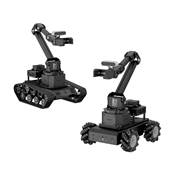
- Why Choose It: Best for large workspace, higher payload, and advanced Embodied AI or multi-device projects.
Purchase Guide
- Budget-Friendly & Entry-Level → ArmPi Ultra: Best if you are new to ROS, have a limited budget, and want to master foundational principles, 3D vision grasping, and basic Embodied AI.
- AI Algorithms & Edge Deployment → JetArm: Best if your core focus is software and local AI inference using NVIDIA Jetson GPU compute.
- Advanced R&D & Embodied AI → NexArm ROS: Best if you need maximum mechanical performance, LeRobot support, or plan to build complex full-stack and multi-robot systems.
Comparison Table
Comparison Table
| Feature | ArmPi Ultra | JetArm | NexArm ROS |
|---|---|---|---|
| Positioning | Cost-effective entry-level ROS 2 vision arm | ROS arm focused on edge AI compute | Flagship Embodied AI and ROS 2 full-feature platform |
| Supported Controllers | Raspberry Pi 5 only | Jetson Nano, Orin Nano, and Orin NX | Raspberry Pi 5 and Full Jetson Series |
| Max Reach | 358 mm | 429 mm | 500 mm |
| Core Actuators | 25 kg·cm serial bus servo | 35 kg·cm serial bus servo | 65 kg·cm dual-shaft magnetic encoder serial bus servo |
| Motion Control | Inverse kinematics | Inverse kinematics | Inverse kinematics, 12-bit real-time magnetic feedback, trapezoidal acceleration, curve interpolation |
| Vision & Voice | Aurora 930 Pro with AI Voice Interaction Box | Gemini Plus with AI Voice Interaction Box | Aurora 930 Pro with AI Voice Interaction Box |
| Core Capabilities | ROS 2 basics, 3D grasping, basic Embodied AI | ROS 1 and ROS 2, edge deep learning, foundation model deployments | Full-stack ROS 2, Embodied AI R&D, imitation learning, multi-robot coordination |
| Best For | Budget-limited users seeking maximum value to master foundational ROS 2 workflows and standard vision grasping | Software-focused developers needing NVIDIA GPU compute for complex local AI inference, visual tracking, and cutting-edge foundation model deployment | Users needing superior reach, payload, and motion smoothness for Embodied AI scenarios or full-stack multi-robot collaborative systems |